 Pawar & Sons
Road & highway crossings
Stormwater drains, sewers and water mains under city roads, national and state highways, and ring roads, with traffic running throughout.
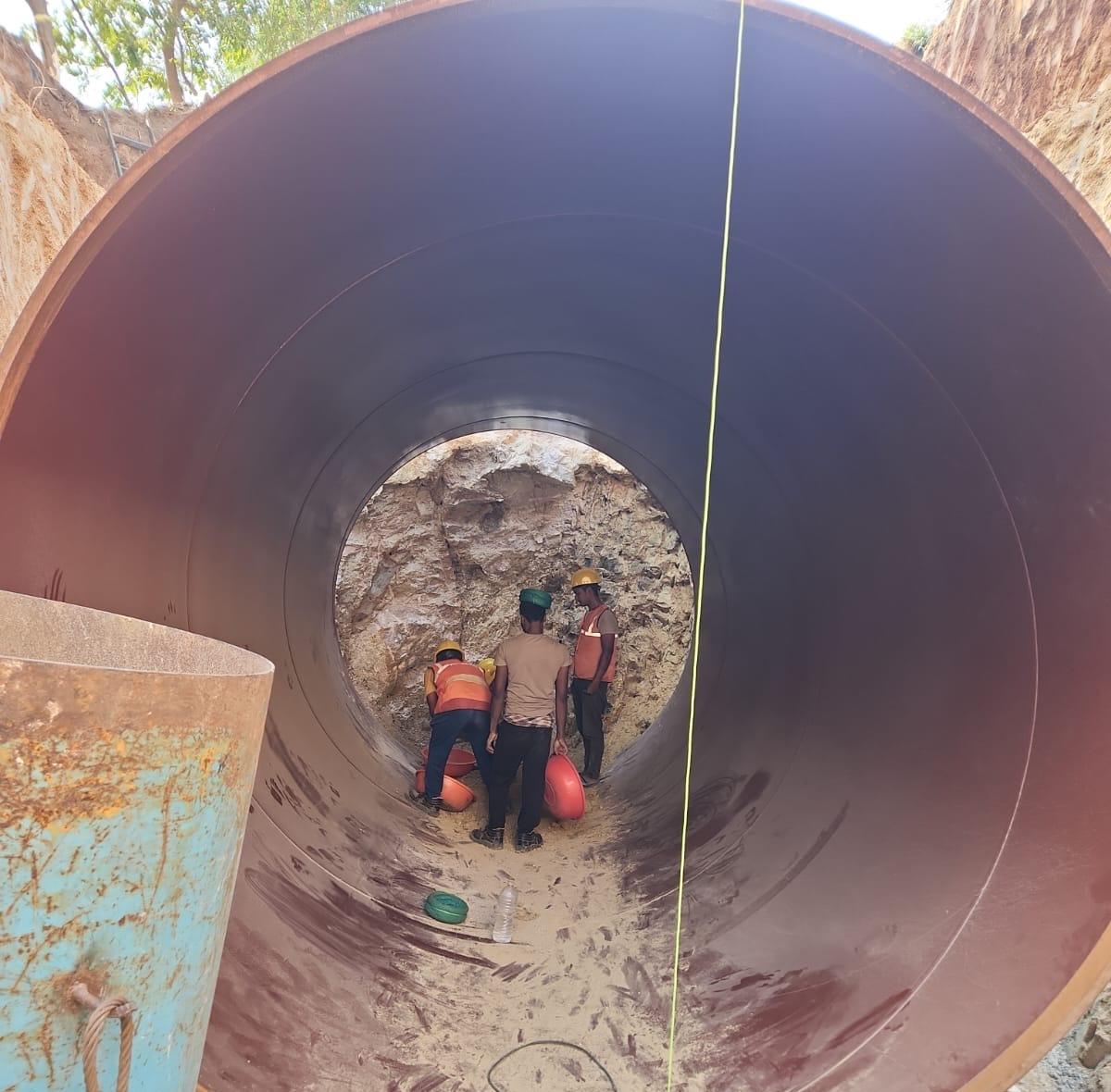
We push man-entry RCC and steel casing pipes under roads, highways, railway lines and buildings. Hydraulic jacks drive the pipes from a launch pit while our crew excavates by hand at the face, so nothing above has to close.
The pipe goes under. The road stays open.
Manual pipe jacking, also called pipe pushing or jack pushing, is the most dependable trenchless method for short and medium crossings in Indian ground conditions. It handles mixed soils, murrum and boulders, because a person at the face can see and remove whatever is there.
Compared with open cutting, there’s no road closure, no resurfacing across the carriageway, and far less risk to the cables and pipes already buried along the route.
Wherever a new line has to pass under something that can’t be dug up or shut down.
Stormwater drains, sewers and water mains under city roads, national and state highways, and ring roads, with traffic running throughout.
Steel casing pipes and RCC box-line crossings beneath running tracks and embankments, carried out to the railway’s approved method and supervision.
Pipes taken beneath drains, nalas and irrigation canals without diverting the flow.
Lines passed under compound walls, factory sheds, airport and industrial premises where surface work isn’t possible.
New trunk lines and outfalls in built-up areas where a trench would block access to homes and shops.
Casing pipes for power cables, telecom ducts, water and gas carrier pipes, sized to take future lines.
Manual jacking needs a person inside the pipe, so it suits man-entry diameters, generally around 900 mm and larger. We confirm the size and drive length for your crossing after the survey.
| Pipe | Typical use | Notes |
|---|---|---|
| RCC jacking pipes (NP4) | Stormwater, sewer, culverts | Heavy-duty class to IS 458, with joints made to take jacking loads |
| RCC pipes (NP3) | Shorter drives, lighter cover | Used where the design and jacking forces allow |
| MS steel casing pipes | Railway crossings, water and gas carriers | Carrier pipe is placed inside and the gap filled |
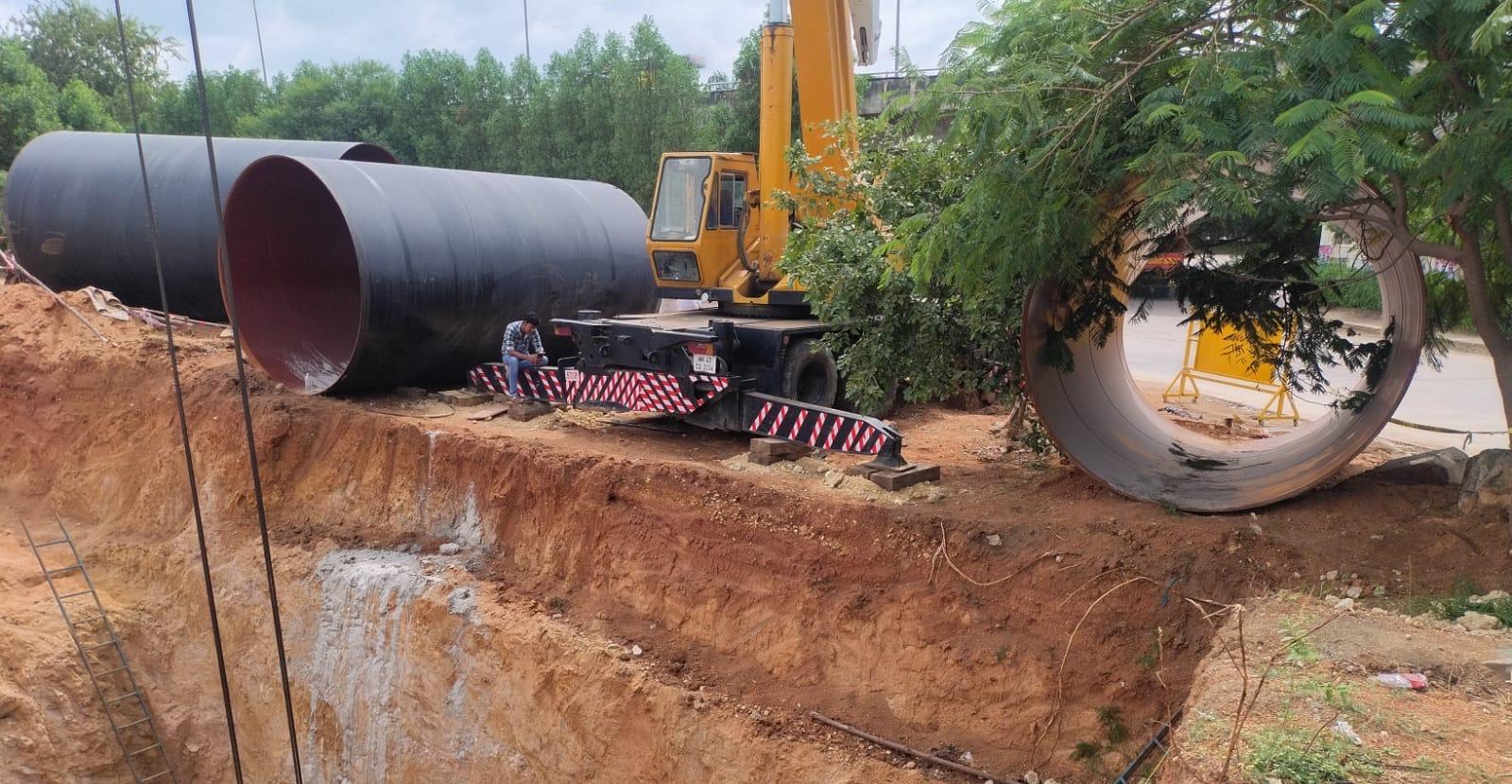
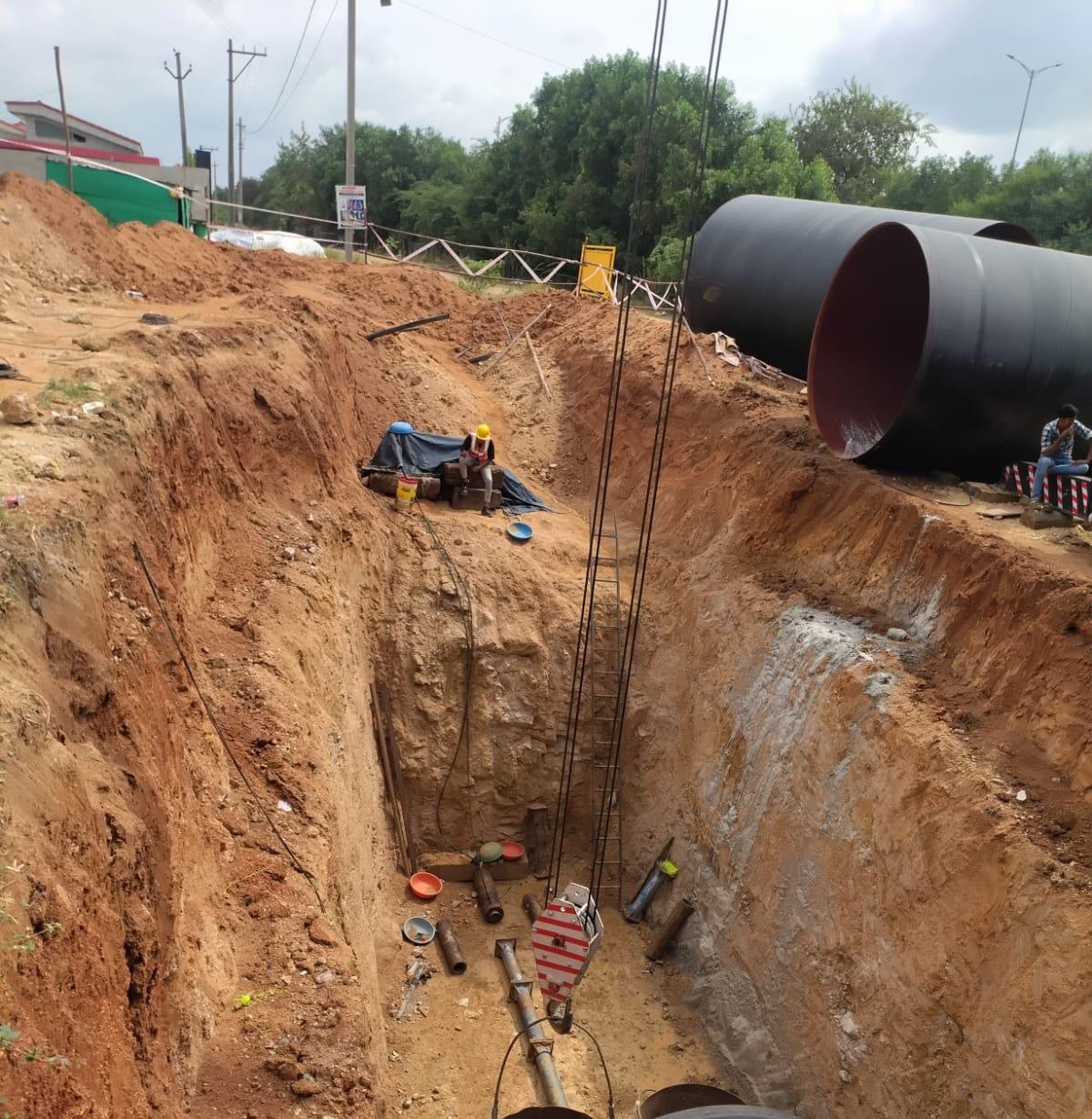
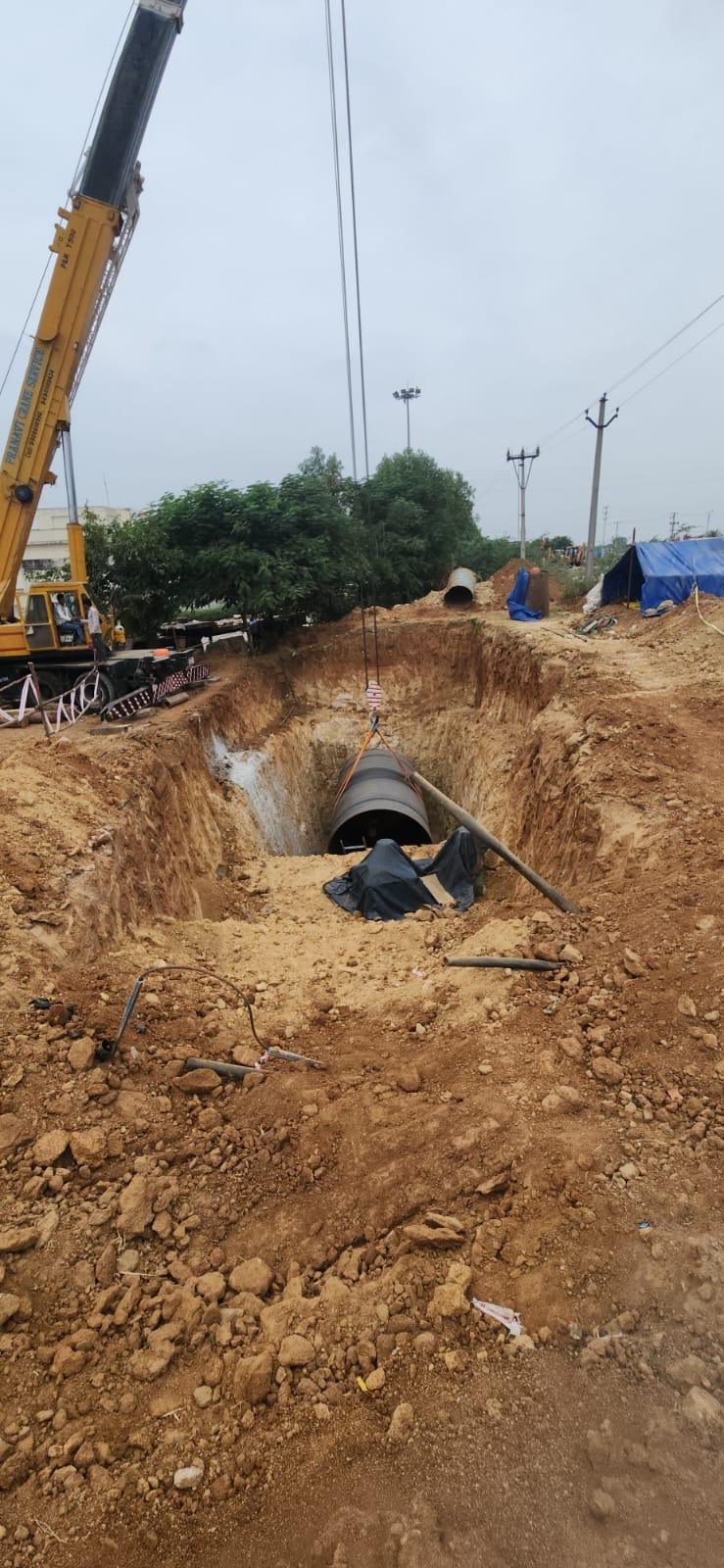
A steel casing pipe crossing under way near the Outer Ring Road in Hyderabad. Our pipe jacking and pipeline clients include Ramky, MEIL and L&T. Tap any photo to enlarge it.
We walk the alignment, locate existing utilities, check soil and groundwater, and fix depth, pipe size and pit positions.
Pits are excavated and shored at both ends, with dewatering if the water table is high.
A reinforced concrete thrust wall is cast behind the jacks, and steel guide rails are set to the design line and level.
The crew excavates at the face inside the lead pipe while hydraulic jacks push the string forward, one pipe at a time.
Alignment is checked at every pipe and corrected at the face, so the line arrives on target at the receiving pit.
The annular gap is grouted, joints are sealed, and both pits are backfilled, compacted and restored.
One team from the first trial pit to the final backfill, with our own jacks, power packs and pit equipment.
It depends on pipe diameter, soil, and the load the pipes and thrust wall can take. Most road and railway crossings are well within the range of manual jacking; longer drives can use intermediate jacking stations. We confirm the drive length after a site survey.
Reinforced concrete jacking pipes, commonly NP4 class to IS 458, for stormwater, sewer and culverts. Mild steel casing pipes for railway crossings and for carrier pipes such as water and gas lines.
Yes, with dewatering at the pits and along the alignment where needed. We check the groundwater level during the survey and plan the method around it.
No. All work happens in the pits at either side, so traffic and trains keep running above the crossing.
Send the location, pipe size and length, plus any drawings or approvals you already have. We’ll visit your site in Bengaluru or Hyderabad and send a method and quote.